
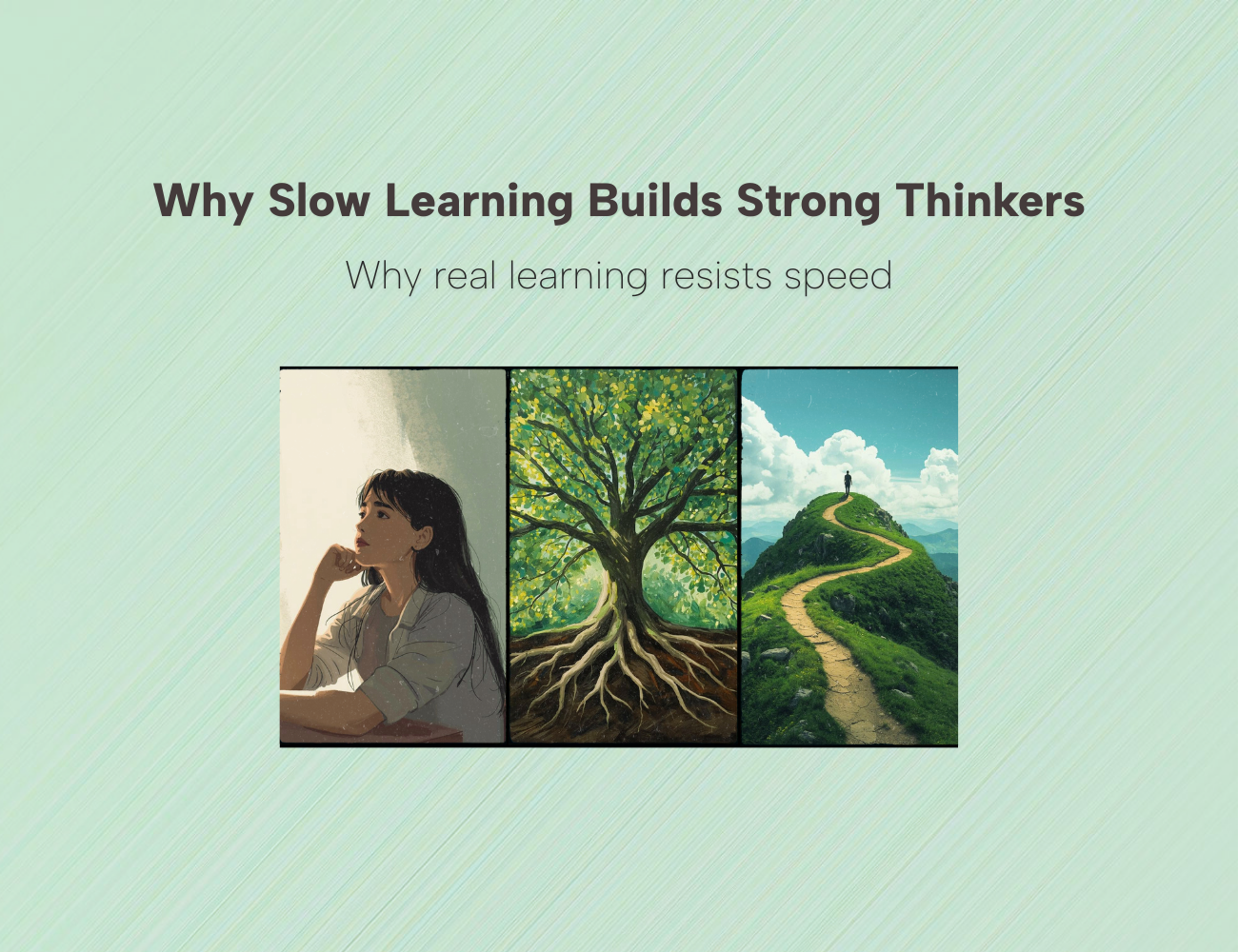
Why real learning resists speed
Learning in a Hurry
We live in a time that celebrates speed. Faster syllabi. Faster results. Faster answers. Students are encouraged to move quickly, cover more, and stay ahead. Apparently, this is what progress looks like.
However, learning was never meant to be rushed. Understanding takes time to settle. Ideas need space to mature. When learning moves too fast, thinking becomes shallow, and knowledge remains fragile. Students may advance quickly, but they often struggle to explain what they truly understand.
Slow learning does not mean falling behind. It means allowing the mind to engage deeply, question freely, and connect ideas meaningfully. In a world obsessed with pace, choosing to learn slowly is not weakness. It is a deliberate commitment to thinking well.
Speed Versus Understanding
Speed gives the illusion of progress. When students move quickly through material, it often feels productive. Chapters are completed, notes are filled, and timelines are met. However, speed does not guarantee understanding. It only guarantees movement.
Understanding asks for something different. It requires pause. Time to revisit ideas. Space to make mistakes and correct them. When learning is rushed, students memorise patterns without grasping meaning. They know what to write, but struggle to explain why it works.
Apparently, this is why fast learners sometimes falter when problems change slightly. Their knowledge is shallow because it was never given time to settle. Slow learning allows ideas to root themselves. It gives students the confidence to adapt, not just repeat.
Strong thinkers are not formed by how quickly they move forward, but by how deeply they engage with what they encounter.
Why Slowness Strengthens Thinking
Slowness creates room for thought. When students are not rushing to keep up, they begin to notice patterns, connections, and gaps in their understanding. They learn to sit with questions instead of immediately searching for answers. This is where thinking deepens.
Strong thinking is not reactive. It is reflective. Slow learning encourages students to examine ideas from different angles, test their assumptions, and refine their understanding over time. Apparently, this process feels uncomfortable at first because it demands patience. But that discomfort is a sign of real learning taking place.
When learning slows down, students stop chasing correctness and start pursuing clarity. They become less afraid of uncertainty and more confident in their ability to reason through it. This is how slowness builds thinkers who are resilient, adaptable, and capable of independent judgment.
The Cost of Learning Too Fast
When learning moves too quickly, its costs are not immediately visible. Students may appear efficient and productive. Syllabi are completed on time, tests are cleared, and progress looks smooth on the surface. However, the cracks show up later.
Fast learning often replaces thinking with copying. Students rely on patterns, shortcuts, and memorised structures. When faced with unfamiliar problems, they hesitate. Their confidence drops, not because they lack intelligence, but because their understanding was never allowed to mature.
Apparently, speed also weakens attention. Constant movement from one topic to another leaves little room for reflection. Over time, students lose patience with complexity. They expect quick answers and feel frustrated when clarity takes time.
The most serious cost, however, is emotional. Learning too fast teaches students to equate worth with performance. When results dip, self-belief follows. Slow learning protects against this. It builds steadiness, not dependency on outcomes.
Slow Learning and Long-Term Retention
What stays with us is rarely what we rushed through. Information absorbed quickly is often forgotten just as fast. However, ideas that are revisited, questioned, and applied over time tend to last. Slow learning strengthens memory because it allows understanding to form in layers.
When students spend time with a concept, they build multiple connections around it. They relate it to earlier learning, real-life examples, and their own reasoning. Apparently, this layered process makes recall easier and application more flexible.
Strong thinkers rely on principles, not fragments. Slow learning helps students remember why something works, not just how to reproduce it. This is why learners who move at a measured pace often outperform fast learners in unfamiliar or complex situations. Their knowledge has depth, not just reach.
The Role of Reflection in Slow Learning
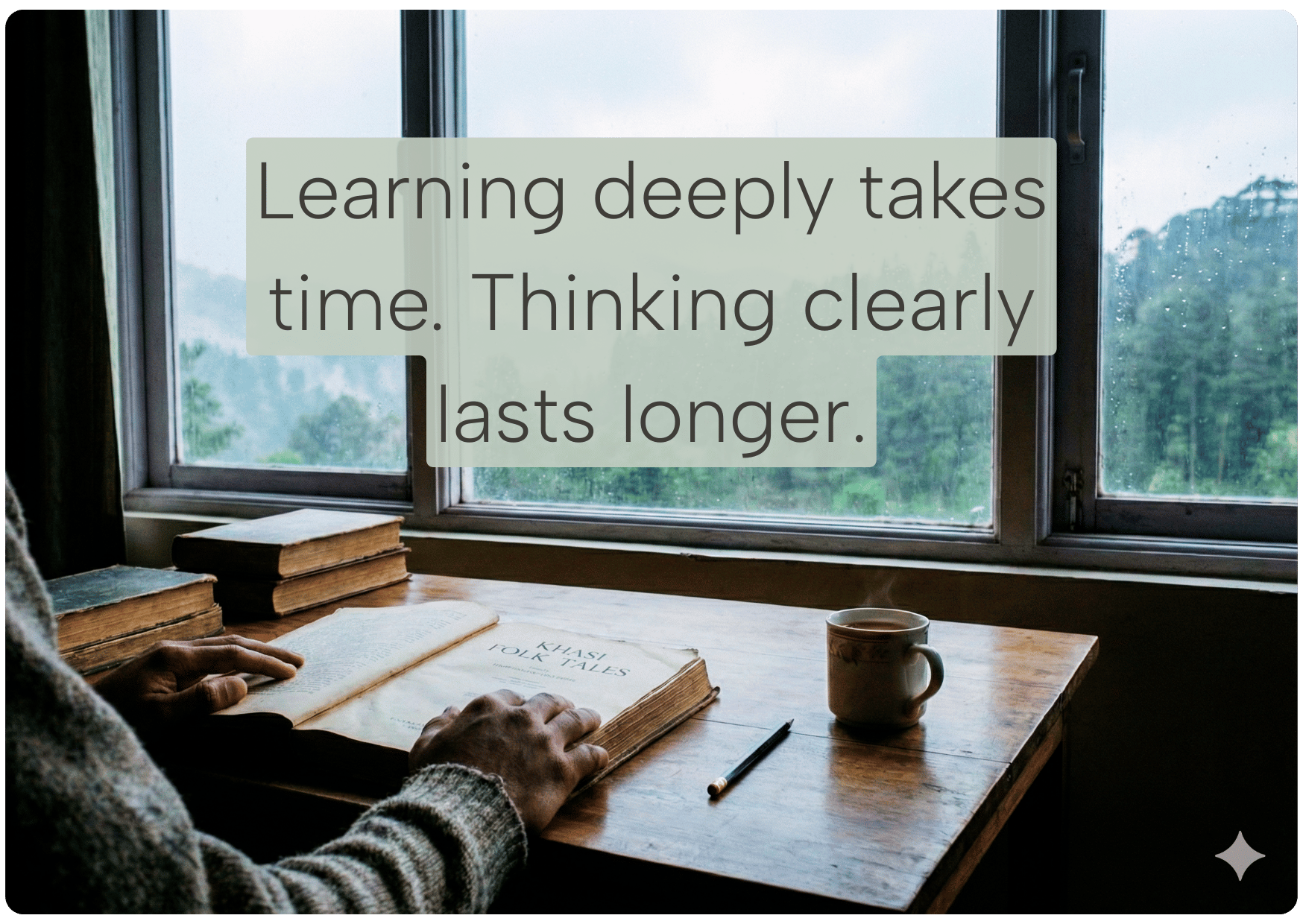
Reflection is what turns experience into understanding. Without it, learning remains incomplete. Slow learning creates the space reflection needs. It allows students to look back, reconsider, and make sense of what they have encountered.
When students pause to ask themselves what they understood, what confused them, and why a concept mattered, learning deepens naturally. Apparently, this pause is often skipped in fast-paced environments where moving ahead feels more important than looking back.
Reflection builds self-awareness. It helps students recognise how they think, where they struggle, and how they improve over time. This awareness strengthens judgment and confidence. Instead of depending on constant feedback, students learn to evaluate their own understanding.
Strong thinkers are shaped by this habit. They do not rush to conclusions. They reflect, refine, and respond with clarity. Slow learning makes this possible by giving the mind permission to settle before it moves on.
Patience, Discipline, and the Making of Strong Thinkers
Strong thinking is built on patience. The ability to stay with a problem, to revisit an idea, and to resist rushing toward answers develops only over time. Slow learning nurtures this patience by teaching students that clarity cannot be forced.
Discipline follows naturally. When learning is not hurried, students learn to commit to steady effort rather than short bursts of intensity. Apparently, this kind of discipline is quieter and less dramatic, but far more reliable. It builds consistency instead of dependence on motivation.
Together, patience and discipline shape thinkers who are resilient. They are comfortable with complexity and willing to engage deeply. Slow learning does not promise quick results. It promises lasting strength. And that strength shows up not just in academics, but in how students approach challenges throughout life.
Choosing Depth in a Fast World
Choosing to learn slowly is a deliberate act. It goes against the current of constant acceleration and instant results. However, depth has always required time. Strong thinkers are not shaped by speed, but by sustained attention and thoughtful engagement.
In a fast world, slow learning offers stability. It allows students to build understanding that holds under pressure and adapts to change. Apparently, this is why those who learn deeply remain confident even when circumstances shift. Their thinking is grounded, not reactive.
Real learning resists speed because meaning cannot be rushed. When students choose depth over pace, they learn more than content. They learn how to think clearly, judge wisely, and grow steadily.
That is the quiet strength of slow learning.