
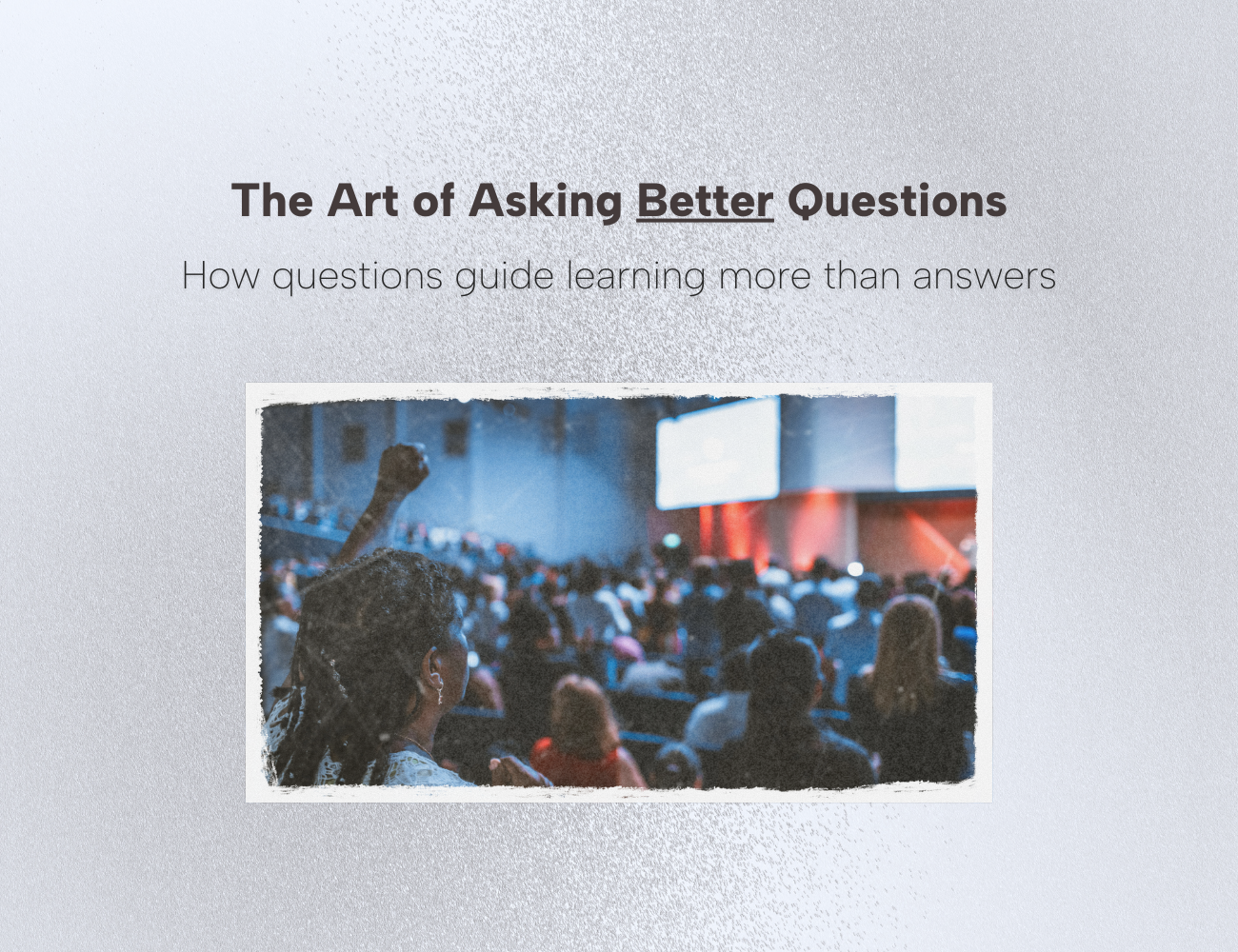
How questions guide learning more than answers
Learning Begins With a Question
Every meaningful learning journey begins with a question. Long before answers appear, curiosity creates movement in the mind. A question unsettles certainty and opens space for thought. Without it, learning becomes passive and fixed.
In classrooms and beyond, students are often rewarded for having the right answers. However, it is the ability to ask the right questions that shapes real understanding. Questions signal engagement. They show a willingness to explore rather than simply accept.
Apparently, when students stop questioning, learning slows. Knowledge may increase, but thinking does not. Strong learners remain curious even when answers are available. They understand that questions do not weaken knowledge. They strengthen it.
Why Questions Matter More Than Answers
Answers bring closure. Questions create movement. This difference is subtle but important. An answer often marks the end of a thought, while a question keeps the mind active and engaged. Learning grows not when something is concluded, but when something is explored.
In many learning environments, answers are treated as success. Students are trained to reach conclusions quickly and move on. However, this approach limits depth. A correct answer can be memorised, but a well-formed question requires understanding. It reveals how a student is thinking, not just what they remember.
Apparently, strong learners are comfortable staying with questions longer. They are not in a hurry to finish thinking. They know that questions sharpen judgment, expose gaps in understanding, and invite reflection. Answers may complete a task, but questions shape the learner.
This is why questions guide learning more than answers ever can. They keep curiosity alive and understanding open-ended, allowing learning to remain flexible rather than fixed.
The Difference Between Good Questions and Quick Questions
Not all questions serve the same purpose. Some are asked to move faster. Others are asked to understand better. The difference lies not in curiosity alone, but in intention.
Quick questions seek shortcuts. They ask, “Will this be in the exam?” or “What is the right answer?” These questions aim for efficiency and closure. They are understandable, especially in competitive environments. However, they rarely deepen learning. They help students move on, but not move forward.
Good questions slow learning down. They ask, “Why does this work?” or “What happens if this changes?” These questions are uncomfortable because they do not promise immediate clarity. Apparently, that discomfort is precisely what makes them valuable. Good questions expose gaps in understanding and invite deeper engagement.
Strong thinkers learn to recognise this difference. They are willing to pause, refine their questions, and sit with uncertainty. Over time, this habit shapes the quality of their thinking. Learning becomes less about speed and more about meaning.
How Questions Shape the Way We Think
The way we ask questions shapes the way we think. Questions train the mind to look beyond the surface and examine ideas more carefully. A thoughtful question encourages reasoning, comparison, and reflection. It asks the learner to engage actively rather than receive passively.
When students ask better questions, they begin to connect ideas instead of memorising them in isolation. They challenge assumptions, explore alternatives, and recognise patterns. Apparently, this habit strengthens judgment and builds intellectual independence.
Over time, questioning becomes a way of thinking. The mind learns to pause before accepting information and to explore multiple perspectives before settling on conclusions. This is how questions shape not just learning outcomes, but the thinker behind them.
Strong thinking grows from this practice. It is cultivated through curiosity that is guided, patient, and deliberate.
The Role of Teachers and Mentors in Encouraging Better Questions
Students learn how to question by watching how authority responds to curiosity. When questions are welcomed, learning opens up. When they are rushed or dismissed, curiosity quietly withdraws. Teachers and mentors play a crucial role in shaping this environment.
A good mentor does not rush to provide answers. They pause. They listen. They ask a counter-question that nudges the student to think a little deeper. Apparently, this restraint teaches more than explanation ever could. It signals that thinking matters more than speed.
When mentors value questions, students learn that confusion is not failure. It is part of the process. Over time, this creates confidence. Students begin to ask without fear of being wrong. They become comfortable exploring ideas instead of performing certainty.
Wisdom is often passed on this way. Not through instruction, but through example. A mentor who thinks carefully, questions assumptions, and responds thoughtfully teaches students how to engage with the world, not just how to answer it.
Asking Questions as a Lifelong Skill
The ability to ask good questions does not end with formal education. It shapes how people grow, adapt, and make decisions throughout life. In many ways, questioning is a skill that becomes more valuable as situations grow more complex.
In professional life, strong questions clarify goals, reveal risks, and open new possibilities. In personal life, they encourage reflection and understanding. Apparently, people who ask well are better equipped to navigate change because they do not rely on fixed answers. They remain open and attentive.
Asking questions also builds humility. It reminds learners that growth comes from curiosity, not certainty. Those who continue to question remain flexible in their thinking and resilient in unfamiliar situations. Learning, then, becomes a continuous process rather than a completed phase.
Strong thinkers carry this habit with them. They understand that the quality of their questions often determines the quality of their choices.
Practicing the Art of Better Questioning
Asking better questions is a practice, not a talent. It develops through awareness and patience. Students learn to question well when they slow down and become intentional about what they are trying to understand.
One simple habit is to move beyond “what” and ask “why” or “how.” These questions invite explanation rather than recall. Another is to pause before asking. Apparently, a moment of reflection helps clarify what the question is really seeking.
Reframing questions also matters. Instead of asking, “Is this right?” students can ask, “What makes this work?” or “Where does this idea fail?” Such questions deepen understanding and encourage independent thinking.
Over time, this practice builds confidence. Students stop relying on external validation and begin trusting their ability to reason. Questioning becomes less about seeking approval and more about seeking clarity.
Staying Curious in a World of Easy Answers
We live in a time where answers are immediate. A search bar delivers solutions in seconds. However, this convenience can quietly weaken curiosity if questions are no longer valued. When answers come too easily, thinking often stops too soon.
Staying curious requires intention. It means resisting the urge to settle quickly and choosing to explore a little further. Apparently, this willingness to linger with questions is what keeps learning alive and meaningful.
Strong learners understand that answers are temporary, but good questions remain relevant. They continue to guide reflection, invite deeper understanding, and open new paths of thought.
In the end, the art of asking better questions is about staying engaged with the world. It is a commitment to thinking carefully, learning deeply, and remaining curious even when answers are readily available.