
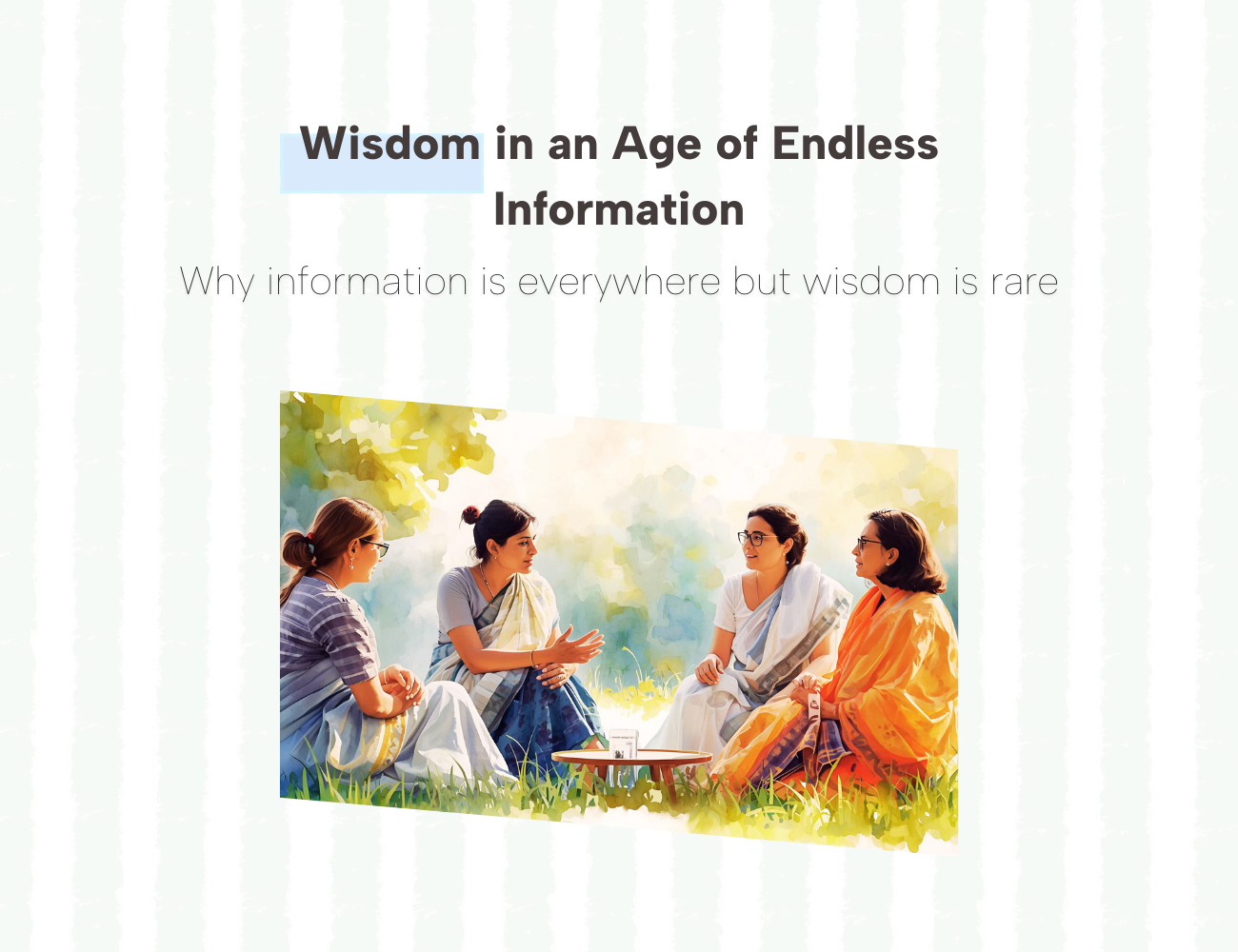
Why information is everywhere but wisdom is rare
We live in a world where information never stops. Students scroll, skim, click, and consume more in one day than entire generations once encountered in a month. Apparently this feels like progress, but it often leaves young minds more overwhelmed than informed.
Modern learners don’t struggle with access. They struggle with excess. Facts are everywhere, but perspective is rare. Knowledge piles up quickly, yet understanding grows slowly. And in the rush to stay updated, students often lose the ability to pause, think, and see things with clarity.
This is why wisdom matters now more than ever. In an age where the mind is constantly fed, learning becomes meaningful only when the student learns how to filter, interpret, and choose deliberately. Information teaches us what things are. Wisdom helps us understand what they mean.
The Difference Between Knowing and Understanding
There is a quiet but important difference between collecting knowledge and developing understanding. Anyone can memorise facts. Anyone can repeat definitions. Ditto for formulas, dates, and theories. But understanding demands reflection. It asks the student to step back and see the bigger picture instead of just the pieces.
Knowing is information. Understanding is interpretation.
One fills the mind. The other shapes the mind.
A simple example makes this clearer.
A student may know the formula for speed. They can recite it, solve problems, and score well. However, they may not truly understand why speed changes, how distance affects experience, or how the same concept shows up in everyday life. They know the math, but not the meaning.
Or consider another scene. Students may know that overusing screens affects attention. Yet they continue to scroll for hours because they have not yet understood what uninterrupted focus actually feels like, or why it matters. Knowledge sits on the surface. Understanding sinks deeper.
Apparently, it is easy to teach information. It takes patience and wisdom to help someone understand. And that is where the real learning begins.
The Character Gap in Modern Education
Modern education has become exceptionally good at measuring performance. Marks, ranks, scores, and outcomes dominate the conversation. However, in the process, something quieter and more important often gets overlooked. Character.
Students are trained to compete, but not always to reflect. They learn how to perform under pressure, but not how to manage it. Integrity, patience, restraint, and perspective rarely appear on report cards, yet they determine how a student handles success and failure later in life.
Apparently, this imbalance shows up only after students leave formal education. Knowledge helps them enter opportunities. Character determines how they sustain them. Without inner grounding, even capable students struggle with burnout, ethical confusion, or constant comparison.
Real education was never meant to be only about outcomes. It was meant to shape individuals who can think clearly, act responsibly, and remain steady when results fluctuate. When character is sidelined, learning becomes incomplete.
How Information Overload Affects Young Minds
Young minds today operate in a constant stream of updates. Notifications, videos, opinions, and comparisons arrive without pause. Apparently, this feels productive, but it quietly fragments attention and weakens depth of thought.
When the mind is always reacting, it rarely reflects. Students move quickly from one idea to the next without fully processing any of them. Learning becomes shallow, memory becomes fragile, and decision-making turns impulsive. Not because students lack ability, but because their mental space is overcrowded.
Information overload also distorts self-perception. Constant exposure to curated success creates unrealistic standards. Students begin to measure themselves against highlights rather than reality. Over time, this erodes confidence and clarity, replacing growth with anxiety.
However, the issue is not information itself. The problem is unfiltered intake. Without guidance on how to slow down, select carefully, and think deliberately, students remain informed but unsettled. Wisdom begins when the noise is reduced and attention is reclaimed.
Why Wisdom Matters More Than Ever
In a world overflowing with information, wisdom becomes the skill that holds everything together. Knowledge tells students what exists. Wisdom helps them decide what deserves attention. Without it, learning becomes scattered and exhausting.
Wisdom teaches students how to pause before reacting, how to question before accepting, and how to choose deliberately instead of following momentum. These are not abstract ideals. They are practical abilities that protect students from distraction, burnout, and poor decisions.
Apparently, the most successful learners are not always the fastest or the most informed. They are the ones who know when to stop, when to reflect, and when to move forward with intention. Wisdom gives students that inner compass.
More than anything, wisdom anchors character. It helps students act with restraint when emotions run high, stay ethical when shortcuts seem tempting, and remain grounded when success arrives early. In times of pressure and uncertainty, wisdom becomes the quiet strength that keeps learning meaningful and growth sustainable.
Learning That Builds Inner Strength
Inner strength is not built through information alone. It develops when learning encourages students to slow down, reflect, and sit with uncertainty. Wisdom grows in moments where answers are not immediate and effort feels uncomfortable.
When students learn to interpret ideas rather than merely consume them, they become calmer and more resilient. They stop reacting impulsively and start responding thoughtfully. This shift builds patience, self-awareness, and emotional balance. These qualities rarely announce themselves, but they quietly shape how a person handles pressure and change.
Apparently, real strength shows up not in how much a student knows, but in how steadily they think. Learning that builds inner strength teaches restraint, courage, and clarity. It prepares students not just for exams or careers, but for the unpredictable demands of life itself.
Practicing Wisdom in Everyday Learning
Wisdom becomes meaningful only when it shows up in everyday choices. It is not something students acquire all at once. It develops through small, deliberate habits practiced consistently over time.
One simple place to begin is attention. Learning to focus fully on one task, even for a short period, trains the mind to resist constant distraction. Another is reflection. Taking a few minutes after studying to ask, “What did I actually understand?” builds depth instead of speed.
Students can also practice wisdom by choosing quality over quantity. Reading fewer sources more carefully. Thinking through an idea before sharing it. Allowing uncertainty instead of rushing to conclusions. Apparently, these small pauses make learning calmer and more meaningful.
Wisdom grows when students learn to observe before they imitate, question before they accept, and slow down before they decide. Over time, these habits shape a mind that is not just informed, but grounded.
Mentors and the Making of Wise Learners
Wisdom is rarely passed on through instructions. It is absorbed through example. Students learn wisdom by watching how someone thinks under pressure, how they respond to uncertainty, and how they make deliberate choices when outcomes are unclear. A mentor models this calm way of engaging with the world.
In an age of endless information, this matters deeply. Students do not just need answers. They need to see how answers are weighed, questioned, and sometimes set aside. Apparently, the most valuable lessons a mentor offers are unspoken. They appear in pauses, in restraint, and in the clarity with which decisions are made.
Over time, this influence shapes more than learning habits. It shapes character. A student who learns to think before reacting, to choose with intention, and to remain grounded in uncertainty becomes someone of understanding.
Knowledge fills the mind.
Wisdom strengthens the person.
And when learning achieves that balance, education serves its highest purpose.